
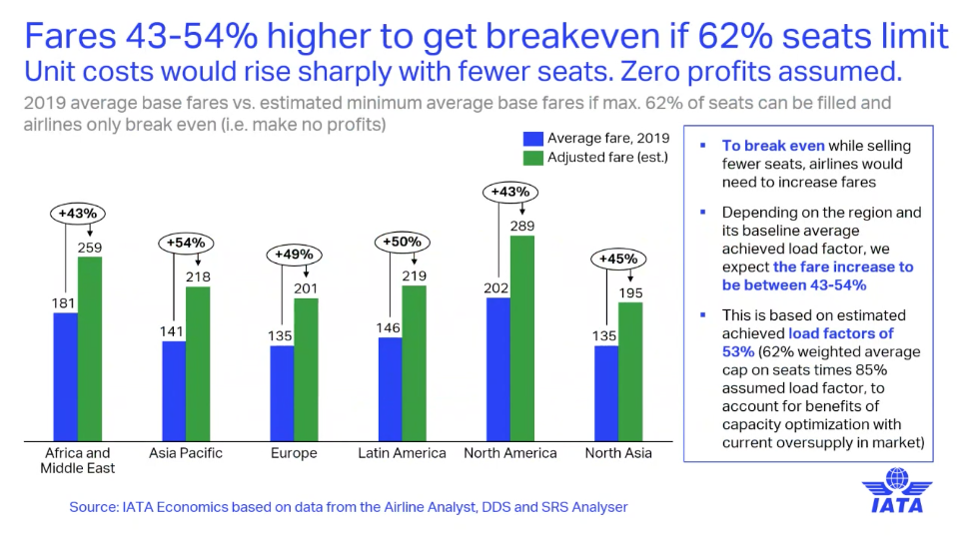
At the beginning of May, the travel restrictions were still in place during an outbreak, while airlines had granted an aid package. Yet some airlines have filed bankruptcy, despite cash burn and with an adequate management of recovery. So far, the airlines had received billions of dollars in federal aid to combine COVID-19 and so as the transportation system (Amtrak). Currently, the airlines may not benefit profitable if the planes aren’t full, losing much as $314 billion in 2020’s revenue in total. Hence, most airline’s temporary load factor has fallen from nearly 100% to about 62%, diminishing them to make a profit. Even though the airlines have recovered in a post-COVID-19 state, it may take several years to recover the loss. This prediction would lead an airfare to rise from 43% to 54% to help the airline break even. Why? Airlines have lost billions of dollars in revenue and cash operating costs, meaning fewer travelers are traveling domestically and internationally. The solutions? Raising prices of airfare may help, but this is not the case, as IATA suggests. This option leads to the only option is to break even of load factors of 77% vs. 62% with appropriate recovery management (Thorbecke, 2020).
Most airlines have older planes that are currently retiring this year rather than the next few years. This retirement of the most antique planes has benefited from the newer planes with less fueling costs, meaning less operating costs and maintenance.
Summary of all travelers who wish to travel this year:
- Airfare is increasing by 50% to twice the cost. Sometimes, airfares may raise 3 times the prices to make up the loss of both operating costs and passenger revenue.
- Middle seats are temporarily unavailable. Airlines passengers will have only options, window or aisle. Seating of seatmates is not permitted.
- All flight crews, flight attendants, workers must wear masks and provide hand sanitizer (hygiene products) on-broad.
- Regularly and rigorously cleaning/sanitizing of airports, security checkpoints, and planes (all cabins) are a must.
- Travelers must wear masks when traveling to limit the spread of infections.
- Travelers must bring a small bottle of hand sanitizer and hygienic wipes abroad.
- Even with a mask, please continue social distancing, 6+ feet from others.
Hence, the airlines and transportation system had started to temporarily remove the middle seat assignments on all flights and seating assignments, giving travelers to practice social distancing. See below for the types of planes and buses.
What’s required:
According to the Public Health Officials, travelers are advised to wear masks when you are traveling. Please, keep in mind that even though hand sanitizer is available, bring a bottle of hand sanitizer. We have advised you to continue social distancing and maintain proper hygiene. Health and safety are the most priority.
What’s changed in airlines’ seating requirements:
For all flights, the check-in counters have temporarily eliminated all middle seats (if applicable). Based on the plane travelers will fly, here is the information.
| Types of Planes: | Configuration | Social Distancing Seating Assignments |
| Regional | Coach: 1-2 (A, BC) Coach: 2-2 (AB, CD) | For 1-2: A and C, only 2 passengers per row For 2-2: A or B and C or D |
| Narrow Body | First/business: 2-2 or 1-1 Coach: 2-3 (AB, D-F) Coach: 3-3 (A-C, D-F) | First: only 2 passengers in each row, no seating next to passengers is allowed For 2-3: A or B, and D and F For 3-3: A and C, and D and F, no middle seats allowed |
| Wide Body | First/Business: No seating of next to passengers allowed Economy: 2-3-2 (AB, C-E, FG) Economy: 2-4-2 (AB, C-F, GH) Economy: 3-3-3 (A-C, D-F, G-I) Economy: 3-4-3 (A-C, D-G, H-J) | First/Business: No seating next to passengers is allowed For 2-3-2: A or B, C and E, and F or G For 2-4-2: A or B, C and F, and G or H, no seating next to passengers is allowed For 3-3-3: No seating of middle seats For 3-4-3: A and C, D and G, H and J, no seating next to passengers is allowed |
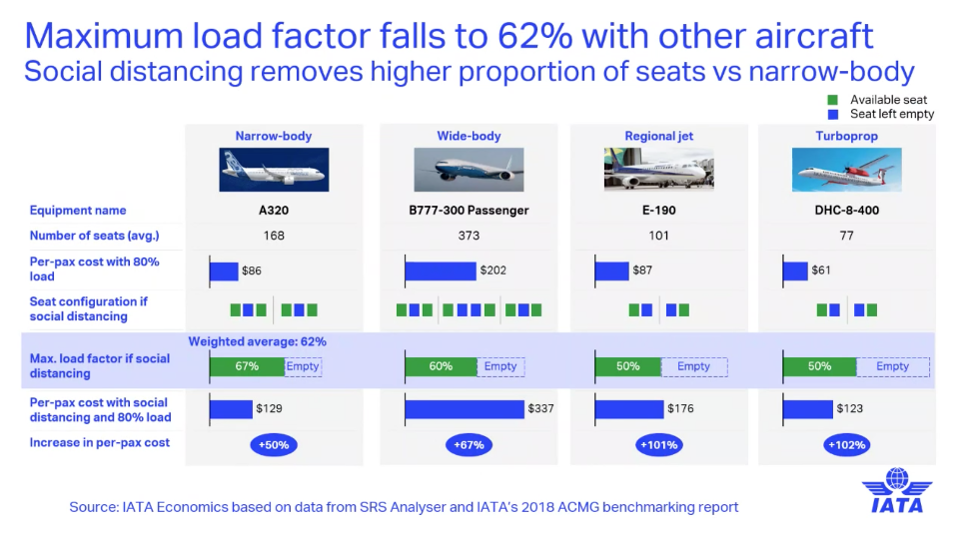
Airlines must practice social distancing to all passengers for the seating arrangements.
What’s changed in bus’ and train’s seating assignments:
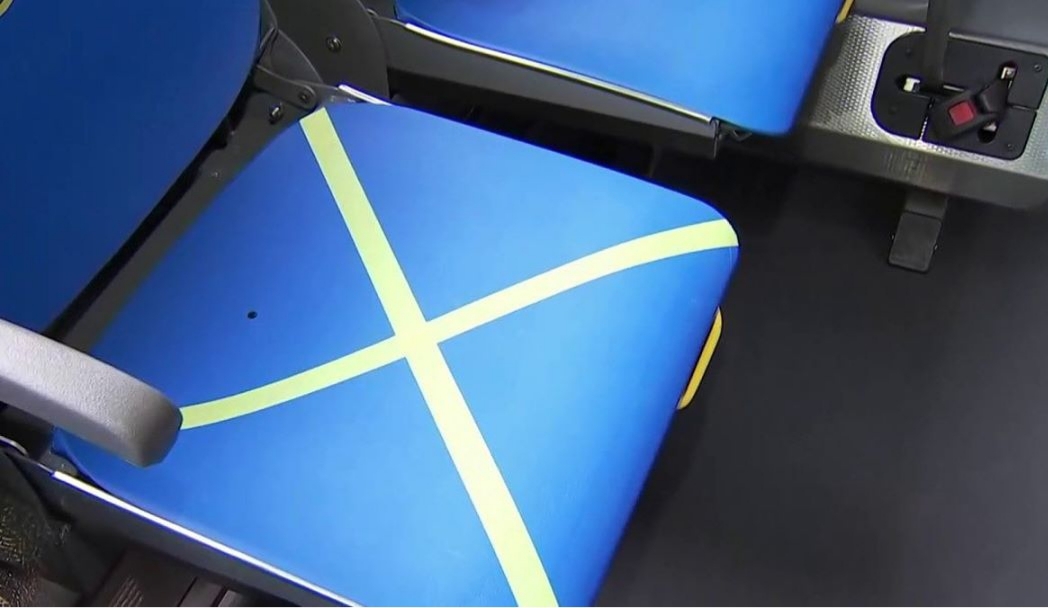
For all buses and public transportation modes, there are limited how many passengers are allowed to practice social distancing. For example, SEPTA still implemented in following vehicles to a certain number of passengers in each vehicle. There will be marked as “X” on the seat to give passengers space to practice social distancing (NBC News Philadelphia, 2020).
| Types of vehicles: | Available Seating (Estimate) | Social Distancing Maximum |
| 40′ Buses | 40-44 | 20 passengers, no seating next to passengers is allowed |
| Articulated Buses | 60-85 | 30 passengers, no seating next to passengers is allowed |
| Minibus | 20-40 | 10 passengers, no seating next to passengers is allowed |
| Trolley or Street Car | 50-75 | 25 passengers, no seating next to passengers is allowed |
| Tram | 50-80 | 30 passengers, no seating next to passengers is allowed |
For travel buses, such as Megabus, the rules apply the same recommendations. There is temporary no seating next to passengers.
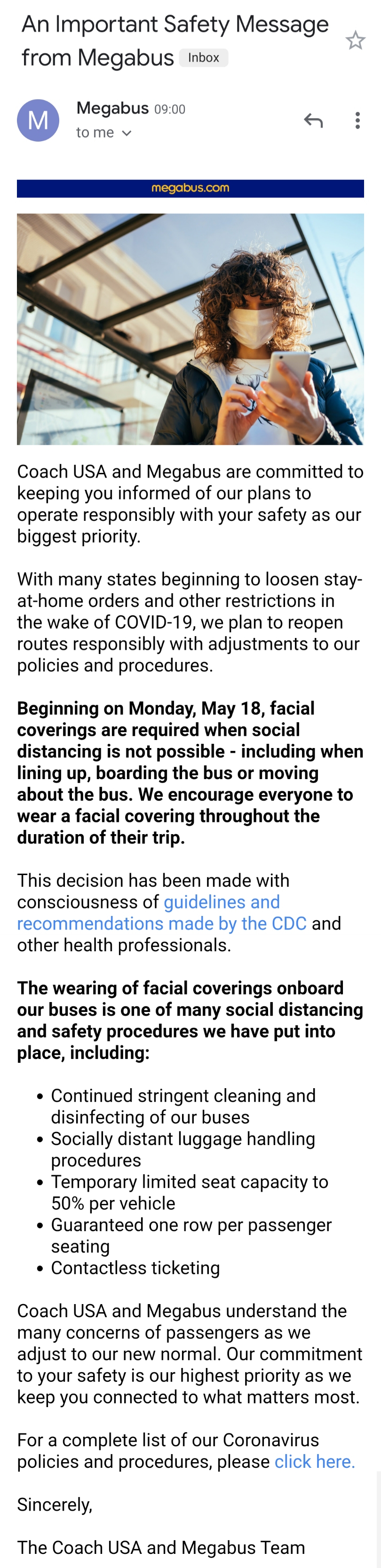
For the train travel, such as Amtrak, the booking of all travelers is limited to 50% booking, meaning that the maximum capacity needed for the social distancing of all passengers (Ralph, 2020). There is no seating next to passengers until further notice.
The World Tourism Organization have implemented its transition for the Covid-19: Putting people first by placing a hashtag for the transformation – #traveltomorrow
The COVID-19 have significantly impacted are Entertainment, Retail, and Tourism industries. The World Tourism Organization has implemented its resilience to recovery by invest in appropriate managerial techniques and through taxes and emergency packages.
What’s important for upcoming travelers (like me):
The current travel level is 4, meaning that travelers should avoid all international travel and only travel if there are “life-or-death” situations such as loved ones and essential workers.
What will happen if travelers attempt to travel abroad:
Here is the devastating news if travelers travel abroad without a travel warning:
- Increase in expose in vital infections
- Lack of social distancing
- Feel ill or sick, even through a traveler is healthy or well
- New cases of infection may appear without noticing any signs
- Countries with a lack of health infrastructure
- Travelers are stranding abroad
We don’t want travelers to get infected or sick, so I am telling them to stay home, practice social distancing, and wear masks in public.
To combine COVID-19 outbreak, all travelers, no matter the age, health, race, under any circumstances, must follow it’s health recommendations when traveling from one place to another.
Even though it is a staycation, please wear masks. We mean it.
Just because travel restrictions have lifted doesn’t mean you are ready to travel. The Department of State had still suggested against all international travel until further notice, meaning that travel had a high risk of infections from people to people. It would help if you stayed home and only travel only for essentials, not for leisure. The vaccine to the public is a year from now, working with the federal and government approval, step-by-step testing, and authorization.
What if COVID-19 doesn’t happen in 2020?
If were the COVID-19 were not happening, I probably worked as the Mortgage Company as a Receptionist at Chinatown and already confirmed my flight to Singapore on United. I also planned my Singaporean trip in September 2020. Again, I would start looking for a hostel today and work hard on my permanent jobs in addition to Temple. In summary, if the COVID 19 did not happen around the world, I will probably travel while working hard and plan a dream trip. I know what the future will look like.
Today was May 15, 2020.
References:
Garcia, B. (2020, May 5). Airlines Warn Of 54% Higher Fares With Social Distancing, Argue Likelihood Of Transmission In-Flight Is Low. Forbes. Retrieved from https://www.forbes.com/sites/marisagarcia/2020/05/05/airlines-warn-of-54-higher-fares-with-social-distancing-argue-likelihood-of-transmission-in-flight-is-low/#42907920696e
Martinez, M. (2020, May 15). Marked Off Seats, One Direction Entry: SEPTA Puts New COVID-19 Measures in Place. NBC News Philadelphia. Retrieved from https://www.nbcphiladelphia.com/news/transportation-and-transit/marked-off-seats-one-direction-entry-septa-puts-new-safety-measures-in-place/2397313/
Ralph, P. (2020, May 8). Amtrak riders now required to wear face masks due to COVID-19 pandemic. Philly Voice. Retrieved from https://www.phillyvoice.com/amtrak-customers-required-face-masks-coverings-trains-stations-coronavirus-covid-19/
Thorbecke, C. (2020, May 6). Airfares could rise 50% with onboard social distancing, industry group warns. ABC News. Retrieved from https://abcnews.go.com/Business/airfares-rise-50-onboard-social-distancing-industry-group/story?id=70532220
World Tourism Organization. COVID-19: Putting people first. Retrieved from https://www.unwto.org/tourism-covid-19

 I-Powers Travel - Tips, Tricks, and Stories