
Dreaming of flying from Hong Kong to Newark last January, it was the fastest plane speed [like the 730 miles per hour over the north Pacific Ocean] but not as fast as a supersonic speed. I wondered what it would be like in the future.
I queried what United would come next.

It was a surprise when United temporarily archived their photos and told [United members] for the exciting updates.
“Hey, MileagePlus Members, we have a surprise!”
The next day…
Waking up refreshed, it was late in the morning and almost late to work [as a blogger]. I found out that United has posted a photo on Instagram, hypothetically a surprise.
It was a photo of a supersonic flight.
Then I replied “👏 👏 👏“

I was surprised and fascinated with the plane, so I started to think about writing about supersonic flight. I later narrowed down what it’s like to fly on a flight with a detailed story of what you felt like on a supersonic jet, an Overture Boom plane.
First, I have two articles about the supersonic flight for others to read and learn about supersonic air travel.
What is the supersonic flight?
Supersonic flights are the fastest commercial flights, reaching a dream destination in half the flight time. It flies faster than the speed of sound, known as Mach.
Info: Mach 1 is 767 miles per hour (1,235 kilometer per hour)
History of supersonic passenger flight
The first supersonic project was the plane called “Boeing 2707” and “Lockheed L-2000” that cruised at around Mach 3 (about 2,300 mph), which was introduced in the 1960s. It aimed to 250 to 300 passengers. However, the supersonic canceled the project in 1971. This is because the economy was unfavorable. In addition, there was a lack of transparency in the job market for the future.
The first supersonic plane for passengers was built was Tupolev Tu-144, which cruised around Mach 2 (about 1,530 mph). Entered its service in 1968, it primarily served on limited passenger service, months before Concorde was introduced to passenger’s service.
Tu-144’s supersonic cabin was very loud ~ about 90 to 105 decibels, exceeding its noise pollution as per the FAA, so I think the flight for passengers was limited.
The Concorde later entered its service in 1969. Rising fuel costs, higher maintenance, and overall investments in money are all of the supersonic operations. As a result, the supersonic flight was subject to significant problems.
Supersonic flights have many fuel costs, heating on the plane’s skin (due to fuel burn), radiation issues (ozone layer), cabin pressurization, design issues, noise pollution, and financial woes that need more money to keep supersonic in operation.
Soon after, specific routes were limited, canceled, or banned due to governmental concerns over certain airports that fly over the populated area, especially the “sonic boom” sound.
Because of the noise over “sonic boom,” it cannot fly over land, citing noise pollution.
The unique plane’s name was called “Concorde” and later introduced its passenger service in 1976 after extensive test flights.
Throughout history, supersonic ran into restrictions such as “sonic boom” overpopulated areas, noise pollution, and frequent overruns and delays that incurred additional incurring costs. These delays include heavy maintenance and overhaul that are difficult or almost impossible to perform due to financial restrictions.
Why did supersonic flights decide to retire in 2003?
- Air France 4590 that Concorde crash during take-off
- September 11, 2001 Attacks that impact on air travel
And the steep rising costs of maintenance, operating costs, and other financial difficulties in maintaining its the world’s famous “Concorde.”
After the 2 major disasters, the air travel slump meant the Concorde flights became less popular, forcing travelers to opt for other methods to travel. In addition, the Concorde had now become impossible to maintain its supersonic (costly Concorde plane ticket) and later decided to retire all Concorde flights.
The last supersonic (Concorde) flight was on October 24, 2003, which flew on a final round from JFK to London Heathrow.
Some Concorde planes parked in a museum but needed to reserve or included in the museum’s ticket.
What will the future be like for supersonic travel?
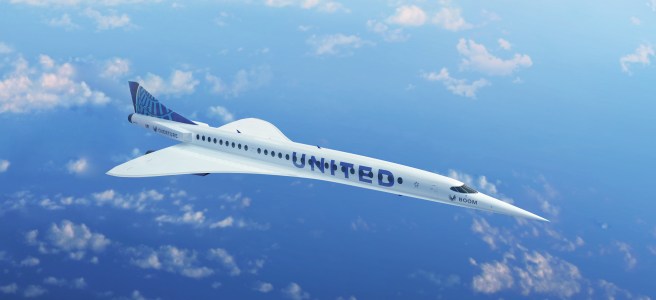
United will invest its future supersonic travel such as Boom Overture that will not like the famous Concorde that will forever change traveler’s lives, saving time for dreadful time on the other planes.
Boom Overture planes will have a quieter cabin too. And they will have a zero fuel efficacy, called Net-Zero Carbon.
And the Boom Overture will work together to regulate its noise level to a minimum as per the Federal Aviation Administration (FAA). Unlike Concorde, the future Boom Overture will change the world after modified fuel efficiency. Like Concorde, the Boom Overture supersonic flight market will primarily target business class passengers and business travelers who have the money to afford to fly on one of the supersonic planes.
What is the name of the plane that will fly on the supersonic?
The supersonic plane will be the Boom Overture.
How’s differ from the Concorde?
There are significant differences when you fly on Concorde in the past. Here is the table of comparison and contrast.
| Boom Overture | Concorde | |
| Size | 205′ length | 202′ length |
| Passengers | 65-88 passengers | 92-120 passengers |
| Configuration | 1-1 layout | 2-2 layout |
| Passenger’s experience | Quieter (Net-Zero fuel efficacy) | Louder (more fuel burn) |
| Ticket cost (when supersonic was still in service) | $15,000 to $25,000* | $10,000 to $16,000 (until 2003) $15,000 to $22,500 (Today) |
| In-flight entertainment | Personalized screens (AVOD) and windows | No (just speed and altitude information) |
| Top Speed | Mach 1.7 (1,300 mph) | Mach 2.2 (1,690 mph) |
| Top Altitude | 60,000′ high | 60,000′ high |
| Range | 4,250 NM (4,800 mi) – Subject to change | 3,900 NM (4,490 mi) |
How will it cost to buy an airline ticket to fly on supersonic?
The ticket price will be the same as the business class ticket, depending on how long and how far the destination is on selected supersonic flights.
What’s it like to fly on a supersonic plane?
The future of supersonic planes is almost like when you fly on a plane, but there are different speeds, altitudes, and experiences.
You can read through what it is like to fly one here.
How long is my flight?
Your flight time will be cut in half, recalculated to the flight time when you fly on a supersonic plane.

Traditional planes vs Supersonic planes
| Airbus or Boeing | Boom Overture | |
| Newark (EWR) – London (LHR) | 6.5 hours | 3.5 hours |
| Newark (EWR) – Los Angeles (LAX) | 6 hours | 3 hours |
| San Francisco (SFO) – Tokyo (NRT) | 10.25 to 11 hours | 6 hours |
| Los Angeles (LAX) – Sydney (SYD) | 14.5 hours | 8.5 hours |
| Paris (CDG) – Montreal (YUL) | 7.5 hours | 3.75 hours |
| Madrid (MAD) – Boston (BOS) | 7.5 hours | 3.5 hours |
| Singapore (SIN) – Dubai (DXB) | 7 hours | 4 hours |
| Los Angeles (LAX) – Seoul (ICN) | 12.5 hours | 6.75 hours |
| Tokyo (HND) – Seattle (SEA) | 8.5 to 9 hours | 4.5 hours |
| Newark (EWR) – Hong Kong (HKG) | 15.75 to 16 hours | 8.5 to 8.75 hours |
| San Francisco (SFO) – Singapore (SIN) | 16.5 to 18 hours | 9 to 9.75 hours |
How fast is the plane?
The new supersonic will be around 1.7 Mach, which is approximately 1,300 mph (2,090 kmh).
How high can Boom Overture plane go up?
The new Boom Overture will fly up to 60,000 feet (11.4 miles).
Tell me what kind of plane United will order?
United ordered up to 50 Boom Overture supersonic planes. United happily will join Boom Overture planes fleets with both Boeing and Airbus planes.
What is the timeline?
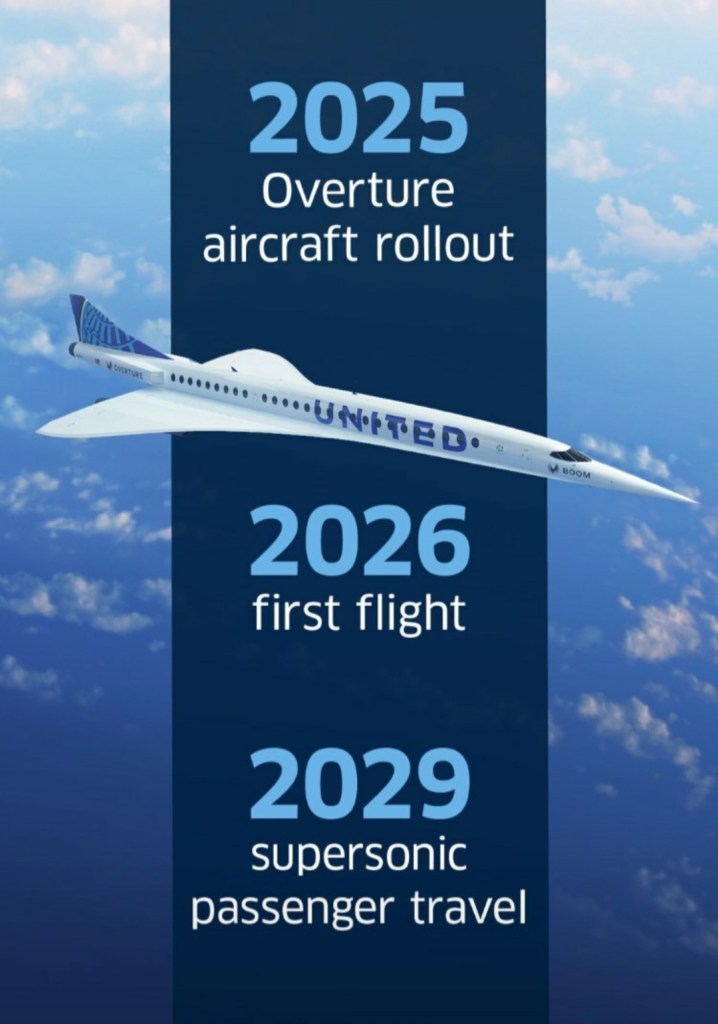
When will the travelers fly on supersonic?
Usually, the earliest flight for passengers will be in 2029, sometimes later. It will be on United Airlines.

 I-Powers Travel - Tips, Tricks, and Stories