

As I endeavored to grow into a more responsible traveler, I realized that tourism-related topics often carry complexities that extend beyond surface-level understanding. The distinction between being a “tourist” and a “traveler” can be likened to various shades of gray, rather than a clear-cut divide. This analogy resonates whether one is exploring local attractions or embarking on an international adventure.
Numerous factors influence this distinction, including behavior, actions, social interactions, dress code, and even physical appearance. For instance, a traveler may embrace local customs and engage in meaningful conversations with residents, whereas a tourist might stick to well-trodden paths and popular landmarks. Additionally, the clothing choices one makes can signal openness to cultural experiences or adherence to traditional tourist attire.
The places we choose to visit also play a significant role in shaping our identities as travelers. Opting for off-the-beaten-path locales often reflects a deeper desire to understand and connect with a destination, while visiting typical tourist hotspots may suggest a more superficial engagement.
I understand that this exploration may seem counterproductive at first, but it is crucial to examine these nuances. In this blog, I will delve deeper into the characteristics that differentiate a “tourist” from a “traveler,” ultimately guiding you to reflect on your own travel experiences and choices. Together, we can uncover what it truly means to journey with purpose and awareness.
How will you describe yourself?
In some specific situations, I consider myself a traveler rather than a tourist, even though I reside in my hometown of Philadelphia, and whether I’m exploring nearby towns or traveling abroad. By dressing casually, adapting to local behavior and communication norms, and immersing myself in the local environment, I find that people are more likely to treat me with respect and accept me as one of their own. This approach also reduces the likelihood of drawing attention from scammers or making a negative impression on onlookers.
As I travel, I immerse myself in the experience, observing and researching various exciting travel topics. From solo traveler safety tips to the latest travel events, I gather the information needed to present comprehensive and engaging content in my blog for the public.
What does a typical “Tourist” look like?
The word “Tourist” seems like a term that describes someone relying just to see the sights for pleasure directly on a guidebook or Google searches, “Places to visit in [fill in the blank].” Tourists were reluctant to step outside their comfort zone and maintain their dress personality like locals do, such as place-specific outfits in specific destinations.
For example, in Philadelphia, I have seen some visitors dressed in a “Hershey” or a plain shirt that displayed an “Eagles” shirt. They also frequently visit the visitor center and pick up the brochure to talk to the front desk, which has more upcoming events. Looking confused, they did not find advice information, leading to a visit, a “waste of time.”
Then, tourists had yet to plan an itinerary, so they decided to visit major chains such as Starbucks or Burger King as the dining source to save money without trying on an authentic Philadelphia experience.
In summary, visiting Philadelphia as a tourist has no purpose.
What does a typical “Traveler” look like?
Becoming an “Authentic Traveler” takes a proactive approach. For example, it is okay to visit popular sites but remember that how you dress and your appearance can make you a “tourist” rather than a “traveler.” Also, be wary of the laws and ethics, and customs too. Mind your social communication too.
For example, I was at Elfreth’s Alley, observing what was featured, researching why it was perseverance, and how Elfreth’s Alley transformed into a popular tourist attraction. Then after seeing the sight, I visit the Philly cheesesteaks to try one of the best, just as Philadelphians taste Philadelphia. Finally, I met others about the importance of these Philly Cheesesteaks and how it’s transformed into a real authentic Philadelphia Travel experience.
In fact, a traveler’s purpose in visiting Philadelphia is to learn the history of the place or just step outside the box to meet the locals. It is part of the learning zone.
Tip: The way you dress and appearance can be a telltale sign.
What is wrong with the picture?
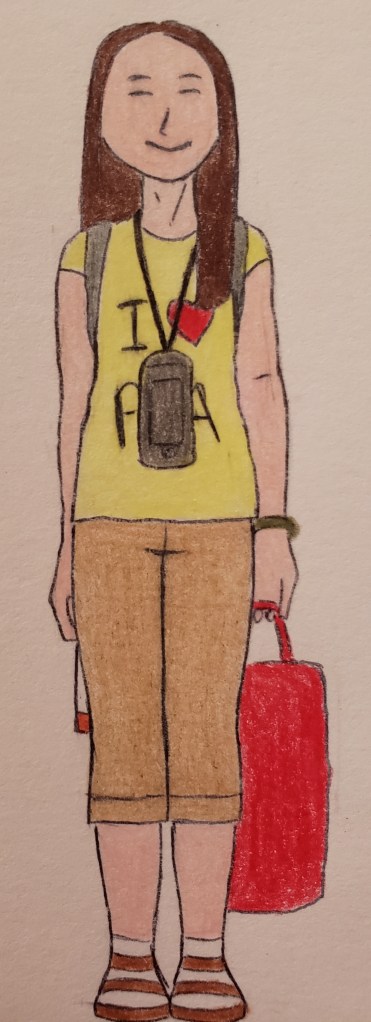
This is how I should dress like a local
Keep it to a low profile to avoid a “tourist” trap.
Dress Code and Appearance:
Tourist (I named her Sussie):
She was dressed in a white “I Heart PA.” It was a bright yellow, plain shirt, wandering herself, getting lost in sight. That is the common mistake most visitors make, to dress randomly.
She was carrying a large backpack, preferably a larger one than her body or to have multi-bags. Larger or multi-bags can make you a target for “scams,” “pickpockets,” or “thieves.”
She displayed her phone in front of her. Also, carrying your maps in public is another indicator. Indeed, a smartphone does have a built-in camera and a map.
She also wears socks over sandals, indicating she is a “tourist” rather than a “traveler.”
Traveler (Me):
I dressed casually without displaying the destination-specific name, such as plain-colored outfits. Dress like locals (Philadelphians) and blend in.
I put my phone inside of the bag. Hint that the bag should be no larger than the body.
I only carried a bag and items needed for the day. Leave unnecessary items behind or at home.
I only wear comfortable shoes whenever possible.
Tip: Only carry a purse or backpack larger than the body if traveling to a new city or on the move. Otherwise, carrying a big backpack or multiple bags indicates you are a “tourist.”
Behavior:
Tourist Sussie:
A girl (I named it Sussie) I saw hanging out at the Old City appeared “lost.” She couldn’t figure out where Betsy Ross’ house was, so she tried to display the map, pointing to the confusion. She might have said, “Help me. I don’t know where I am going.”
She might have looked tired and shy and started to panic.
Traveler (Me):
I knew where I needed to go, and if I was lost, I stopped by and saw the sign, e.g., Betsy Ross’s house on the left. So instead of pulling a map or on the phone, I walked until I found the home. It is best to follow a set itinerary without relying on maps and travel with a purpose of a personal change.
I have an energetic time to enjoy traveling.
Places:
Tourist Sussie:
She wanted to see sights like Betsy Ross House to “explore” without a purpose.
Traveler (Me):
Besides Betsy Ross House, I spotted and led a theme at Elfreth’s Alley, met some people, and talked briefly about the historic place. That place has learned a lot about Philadelphia History.
Here is the overall comparison between the two:
| Tourist | Traveler | |
| Appearance | -Displays as destination-specific bags, personal items, or clothes. -Wears inappropriate shoes such as high heels in Philadelphia or socks with sandals. -Overly wears inappropriate or sloppy clothing in certain situations. | -Dresses in comfortable clothes but, in some cases, stylish. -Wears comfortable walking shoes but not showy or overly bright colors. -Dresses for the weather. E.g., Dresses modesty in Muslim Countries. |
| Behavior relating to personality | -Always have a phone or a map displayed. -Tends to “overpack” or pack more bags. -Expect to speak “English” or not know how to speak the local language. -Reluctant to “stepping outside of the comfort zone.” -Always traveling with a tour group or large groups. -Often with a packed itinerary (often a faster pace) | -Tends to speak the local language, such as “Hello,” “Please,” and “Thank you.” Tries to communicate with each other in the local language but can be imperfect. -Packs only what you need for the trip. Walks with confidence and asks for directions if needed. -Steps out of their comfort zone. -Generally traveling solo (independently) -Often with an itinerary set with free time in hand (slower pace) |
| Purpose of Traveling | -Travel purpose is to see and visit sights, often for pleasure. -Doesn’t partake in travel experiences such as cooking classes or meet new people at events. | -Travel purpose is primarily to see and visit sights but to enhance the in-depth connection of the place and cultures, e.g., blog about the place with a heart of experience. -An authentic travel experience such as a cooking or dancing class, meeting new people locally. |
| How they plan a trip? | -Dependent on traveling agencies or the person who needs help finding popular attractions or simply googling “Place to visit in [fill-in-the-blank]” or in the guidebook. -The trip itinerary is generally “fixed.” | -Independent, usually plan a trip itinerary online and research, including visiting what you dream of visiting based on the bucket list but can change without regrets. -The trip itinerary is generally “flexible.” |
| Trip planning motivation | Tends to be lazy | Tends to engage in daily tasks |
| How do they get around? | Mainly a tour bus | Mainly a public transportation or a private vehicle in some situations |
| Travel Trends | Old-Fashioned Traveler | 21st-Century Traveler |
| How they take pictures | Selfie with lots of pictures | Picture of landmarks, holding your phone with limits with a reflection with a travel blog, journal, or a story |
| Dining | Major chains restaurants, often a fast-food | Localized restaurants, food, and dishes, often family-owned local business |
| Where will they stay? | Generally hotels (popular names) | Generally hostels, but can stay at the locally owned hotels |
| Souvenirs | Buys their popular and/or favorite items and often packs of items | Limits but treated as “souvenirs” as the “trip memories” on the media/digital |
| Effects | -A person sticks out against the crowd. -Can be a “victim” of scams or pickpockets. | -A person blends in with other locals. -People trust your instincts. |
| What does it feel like to travel? | Boring | Fun |
| Goals | Satisfy your travel memories | Transform your travel memories |
| Life? | Escape Life | Experience Life |
In conclusion, to avoid treating differently and to avoid negative impressions for both visitors and residents, you can be both a “Tourist” and a “Traveler.” But, there are exceptions in my travel experience.
Experienced a “tourist” when I practiced traveling and seeing the world confidently, I learned how to navigate the locations without being distracted by their urges to look at the maps frequently or display my wallet in public. That is why you need to become a “tourist” before becoming a “traveler” to enhance a better understanding of how the world works and some events are going on. And after years of practicing and researching, I am now a “traveler” with an open heart and mind.
In my experience, to become a “solo traveler” or “traveler,” you must travel or go on an escorted tour. An escorted tour can help you with many things you need in your adult life. Here is the list I focus on and learn how to grow, such as planning a trip, managing your time, taking on responsibilities, getting engaged in the localized culture, navigating safety, and dealing with emergencies. These skills must be mastered when you are an adult. It is about “maturity,” and things will go on for the rest of your life.

 I-Powers Travel - Tips, Tricks, and Stories